
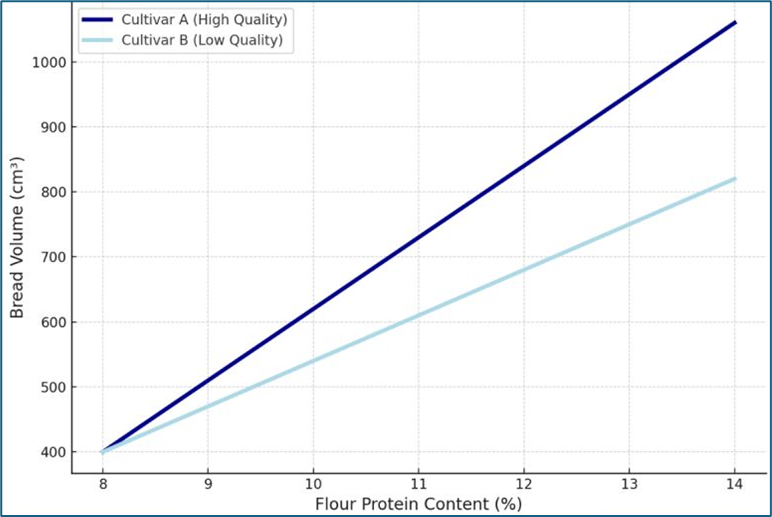
The effect of wheat flour protein quantity and quality on bread volume
Protein quantity ≠ protein functionality.
This graph, conceptualized by A. Bijttebier,
makes that distinction crystal clear…
Despite having the same % protein,
one cultivar consistently produces significantly higher loaves.
🧪 Let’s decode it:
✅ Cultivar A shows a steeper slope
this means that each incremental % of protein translates into a much larger increase in loaf volume.
✅ Cultivar B, with a flatter slope,
reveals that its protein even at similar levels
cannot form a gluten network capable of sustaining gas retention or oven spring.
📍 Both lines intersect near 8% protein, highlighting a well-established concept:
– Below this level,
protein quality plays a limited role. Bread volume is influenced more by starch gelatinization, batter viscosity, and limited gas expansion.
– Above 8%,
however, gluten network formation becomes the dominant performance factor—and protein quality becomes the differentiator.
🧬 What defines protein quality?
– Glutenins (especially high-molecular-weight subunits) create the elastic backbone of the dough.
– Gliadins add plasticity and extensibility.
– The ability of gluten to form a cohesive, extensible, and gas-retaining network is what translates into actual bread volume.
🔺 This is not theoretical.
➡️ In protein reconstitution studies,
gluten from high-quality flour was combined with starch and solubles from poor-quality flours—yet the loaf volume remained high.
➡️ Gluten protein fraction alone dictated the result.
🧰 Why this matters in practice:
For millers, bakers, breeders, and technologists:
– A flour with 12% protein might perform like a 10% or 14%, depending on gluten quality.
– A regression slope like this gives a fast, data-driven estimate of protein effectiveness—with just one standardized bread test and protein %.
– To complement it:
Use SDS sedimentation, Gluten Index, Frainograph , Mixolab, Alveograph P/L, Extensograph, resistance/extension, and controlled bake tests.
📊 Key Insight:
Bread volume is a function of protein’s ability to form and sustain a thermomechanically stable gluten matrix.
Source: #Grainar